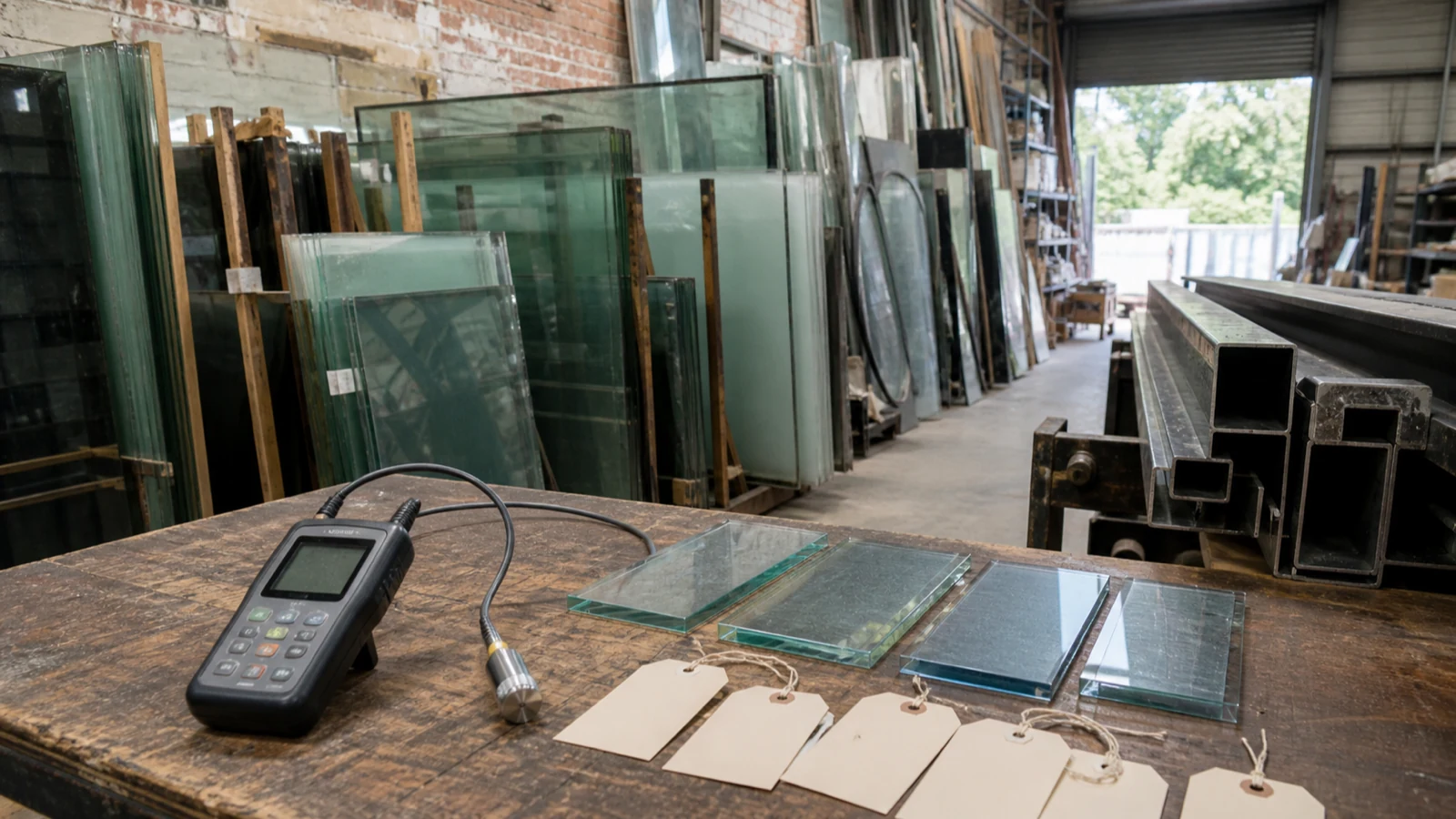
Ultrasonic thickness gauge for reclaimed materials UK: grade glass and metal before pricing
An ultrasonic thickness gauge for reclaimed materials can help UK salvage sellers grade loose glass panes and metal sections by measured thickness instead of eye estimates. It is most useful at intake: clean the contact face, verify the gauge, set the material velocity for glass or metal, record bands consistently, and separate uncertain pieces rather than forcing a number.
There are several tool families in this space. Bohle UK sells specialist glass thickness gauges for glazing measurement, while Merlin Lazer describes laser glass measurement tools for installed units. Those tools help define where optical/laser glass measurement is stronger. Flowline's UK listing supports the multi-material ultrasonic side, including steel, aluminium, glass and plastics with adjustable velocity: Flowline ultrasonic thickness gauge pipe wall measurement.
Salvage intake schedule
- Sort the lot into obvious material groups before measuring: loose glass, steel, aluminium and unknowns.
- Clean a small contact patch. Dust, putty, paint ridges and moisture can ruin repeatability.
- Verify the gauge on a reference before the first lot and after any heavy handling.
- Set or verify the velocity for the material. Do not carry a steel setting into glass.
- Measure several points and record a grade band, not just a single attractive number.
- Put uncertain, laminated, cracked or dirty pieces in a separate inspection pile.
Decision table for reclaimed stock
| Material situation | Ultrasonic handheld fit | Better choice |
|---|---|---|
| Loose solid glass pane with clean access | Possible when velocity and coupling are controlled | Verify against a known pane if pricing depends on it |
| Installed sealed double-glazed unit | Usually not the right tool family | Specialist optical or laser glass gauge |
| Steel or aluminium reclaimed section | Good screening use when material is known | Escalate if structural calculations depend on it |
| Laminated, dirty or uneven glass | Risk of false readings | Clean, identify construction or withhold grade |
Switching between glass and metal
The dangerous moment is not the first reading; it is the second material. A yard worker measures steel, then picks up glass and forgets to change velocity. Build a habit: material group, setting check, reference check, measure, record. If the record sheet cannot show which setting was used, the price grade is weak.
What this will not do
It will not guarantee resale profit, prove load-bearing fitness, or replace specialist glass tools for installed insulated glass units. It can reduce avoidable pricing mistakes on accessible solid materials. For general wall-thickness principles, see non-destructive wall-thickness gauge basics; for mixed-shop buying decisions, see budget workshop gauge choices.
FAQ
Can I measure old glass without cleaning it?
Do not rely on readings from dusty, putty-marked or uneven contact faces. Clean a small area and check repeatability.
Should every piece get a precise label?
No. Use precise labels only where the reading is repeatable and the material is understood. Use grade bands for normal resale work.
When the DigitalUlt gauge is worth checking
If your job is a routine one-side wall-thickness check on accessible material, and you can work within a handheld ultrasonic workflow with calibration discipline, compare the current product details here: Digital ultrasonic thickness gauge. Skip it if you need a certified inspection report, a specialist through-paint corrosion instrument, or glass-unit measurement through sealed glazing.