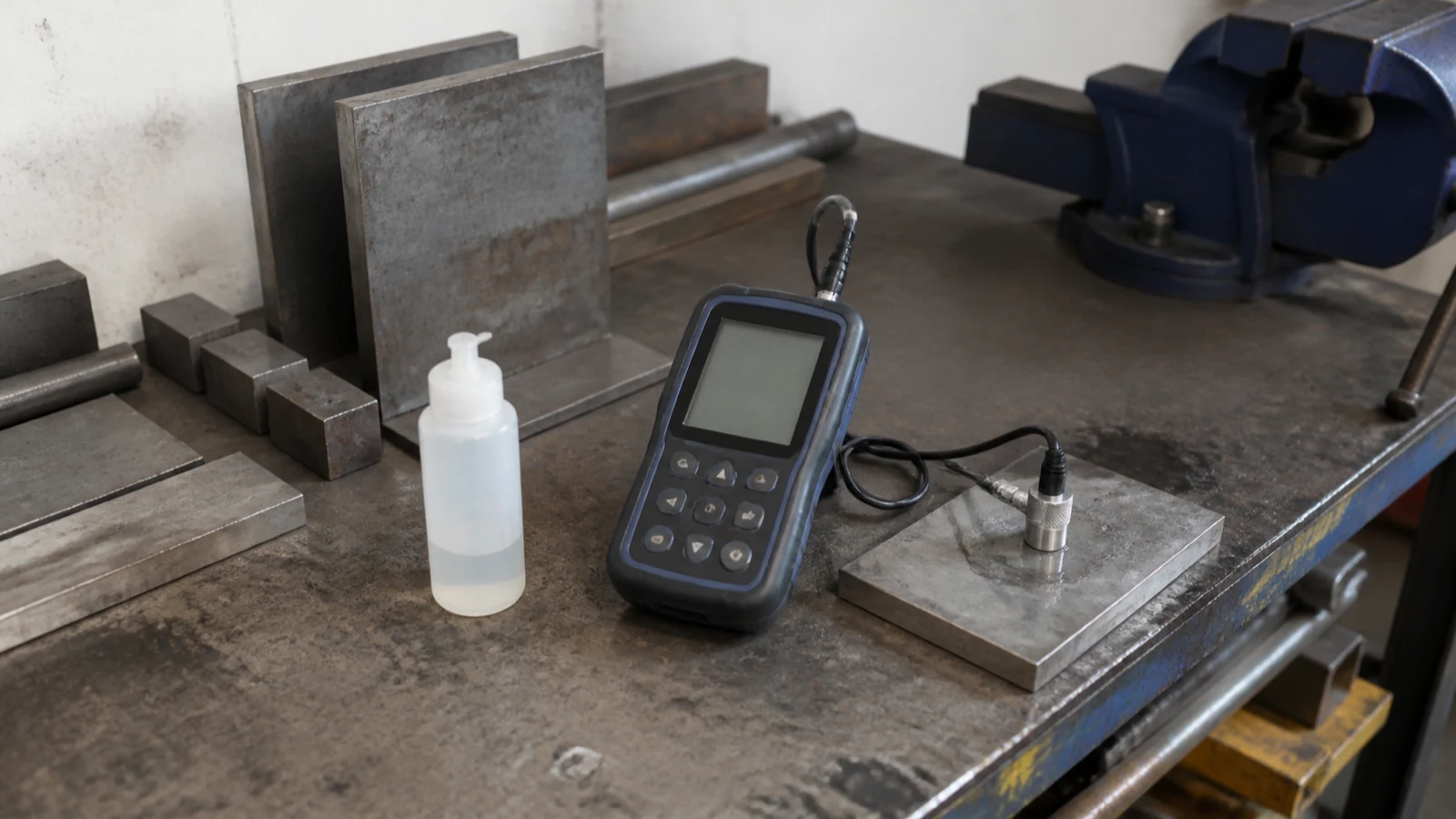
Budget Thickness Gauge For Small Workshop Uk
A budget thickness gauge can be a sensible first ultrasonic meter for a small UK workshop when your jobs are everyday mild-steel plate, pipe, and simple multi-material checks. It cannot replace a certified NDT service, a class survey instrument or a full traceability chain. The buying decision should start with your jobs, surfaces and records, not the lowest price.
The UK market has a wide capability spread. Omni Instruments lists a portable MT160 ultrasonic thickness meter with a built-in calibration test block and multi-material velocity range. Testron frames accuracy, resolution and industrial price-band trade-offs in its UK buying guide: Testron ultrasonic metal thickness gauge guide. At the higher end of common handheld kits, DFT Instruments publishes PosiTector UTG pricing and industrial feature context.
The useful budget zone
Budget handheld gauges are strongest when the material is known, the surface can be prepared, the operator can perform a reference check, and the business needs a quick thickness number for internal decisions. That might mean checking incoming plate, comparing pipe sections before a quote, or giving a customer a practical maintenance note.
Comparison table
| Buying axis | Why it matters | Budget compromise to watch |
|---|---|---|
| Calibration reference | Operators need a quick confidence check | A built-in block helps daily checks but may not replace certified references |
| Adjustable velocity | Different materials need different sound speeds | Preset-only tools can be risky for mixed materials |
| Resolution and accuracy language | Resolution is display granularity; accuracy is measurement confidence | Cheap listings may highlight resolution while burying accuracy limits |
| Through-paint capability | Coatings can distort simple readings | Basic meters often need clean bare contact |
| Data logging | QA records may require stored readings | Manual note-taking is slower and more error-prone |
Who should not buy budget-first
Do not start with a budget gauge if the job is a coded vessel inspection, marine class survey, insurance dispute, UKAS-traceable reporting chain or a contract that names a specific standard or instrument class. In those cases, the cost of the wrong tool is not the purchase price; it is the invalid report.
Before you spend
- List your materials: mild steel, stainless, aluminium, PVC, glass or mixed unknowns.
- List the minimum and maximum thickness you expect.
- Decide whether coatings can be removed.
- Decide who records readings and how they will be checked.
- Budget for couplant, cleaning and operator training, not just the meter.
For pipe-heavy work, compare this with steel pipe wall-thickness checks. For the broader principle, see non-destructive wall-thickness gauge basics.
FAQ
Is a budget gauge inaccurate by definition?
No. It may be adequate for routine checks when used within its limits. The risk is using it for jobs that need a higher-spec procedure or traceable report.
Does a built-in block remove the need for a certified block?
No. It is useful for quick checks, but formal QA may still require a certified reference and written procedure.
When the DigitalUlt gauge is worth checking
If your job is a routine one-side wall-thickness check on accessible material, and you can work within a handheld ultrasonic workflow with calibration discipline, compare the current product details here: Digital ultrasonic thickness gauge. Skip it if you need a certified inspection report, a specialist through-paint corrosion instrument, or glass-unit measurement through sealed glazing.