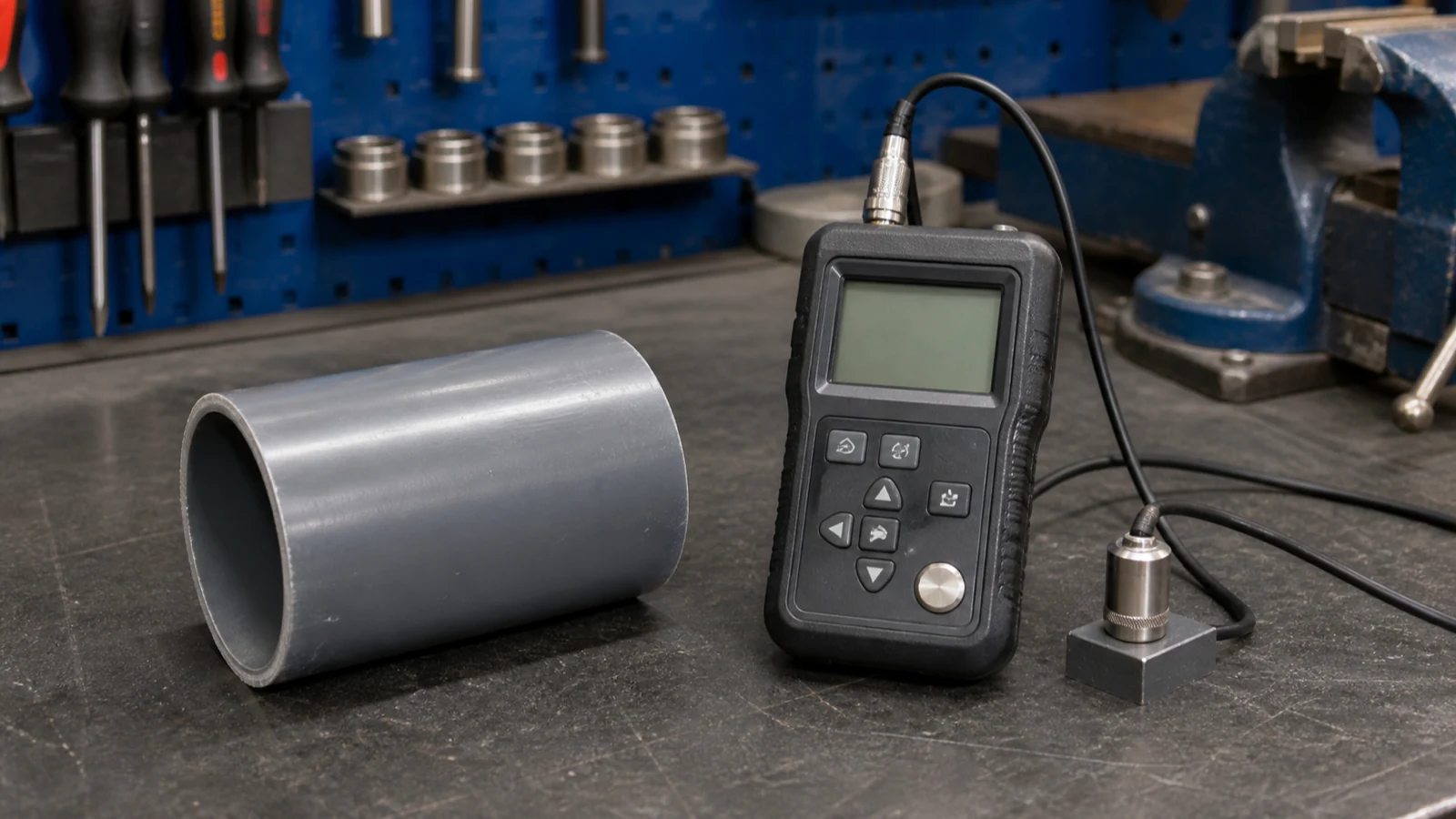
PVC pipe thickness gauge UK: avoid the steel-setting mistake
A PVC pipe thickness gauge is usually not a PVC-only instrument. It is a multi-material ultrasonic wall-thickness meter that must be set or verified for PVC before you trust the reading. The common mistake is leaving the gauge on a steel velocity, coupling the probe to plastic pipe, and recording a confident but wrong number.
UK supplier guidance supports this distinction. DFT Instruments describes plastic pipe quality control as an ultrasonic thickness application when the correct probe and settings are used. York Survey lists portable meters with material databases and user-set velocities, including PVC options: York Survey Portagauge 6 thickness meter.
Checklist before measuring PVC
- Confirm that the pipe is PVC, not painted metal, ABS, PE or a composite.
- Use the gauge material menu or enter a velocity verified against a known-thickness offcut from the same pipe type.
- Clean a small area so the probe sits flat. Curved thin-wall pipe can make probe contact harder.
- Apply couplant. More gel is not a substitute for correct pressure and alignment.
- Take several readings around the circumference and record the lowest repeatable value, not the most flattering one.
Steel vs PVC measurement mindset
| Issue | Steel pipe habit | PVC pipe adjustment |
|---|---|---|
| Velocity | Often a default steel preset | Verify PVC setting on a known sample |
| Surface | Remove rust and scale | Clean dirt, adhesive and surface damage |
| Probe contact | Curvature and corrosion are the main problems | Thin curved plastic and dry contact are common problems |
| Interpretation | May be corrosion screening | Usually wall confirmation, fabrication QC or maintenance comparison |
What the reading can and cannot prove
A handheld ultrasonic reading can help you compare pipe sections, verify a supplied wall thickness, or avoid using a steel assumption on plastic. It does not prove pressure rating, chemical compatibility, installation compliance or long-term fatigue life. For those questions, use the pipe manufacturer's documentation and a competent engineer.
If your work includes both plastic and steel, keep a written setting log. Switching from PVC to metal and back is where human error creeps in. The steel pipe wall-thickness checks guide gives a parallel workflow for steel runs, while the non-destructive wall-thickness gauge basics guide explains the general non-destructive principle.
When to upgrade
Upgrade from a simple handheld meter if you need laboratory plastic extrusion QC, data logging tied to batch records, unusually thin-wall plastic, or a formal procedure that names a particular instrument class. A basic field gauge is useful only when the material, surface and acceptance criteria are simple enough.
FAQ
Can I use a metal thickness gauge on PVC?
Only if it supports adjustable velocity or a suitable material preset and you verify it on a known PVC thickness.
Should I publish one PVC velocity for all jobs?
No. Treat any published value as a starting point. Verify against the exact material or a known sample before recording job data.
When the DigitalUlt gauge is worth checking
If your job is a routine one-side wall-thickness check on accessible material, and you can work within a handheld ultrasonic workflow with calibration discipline, compare the current product details here: Digital ultrasonic thickness gauge. Skip it if you need a certified inspection report, a specialist through-paint corrosion instrument, or glass-unit measurement through sealed glazing.