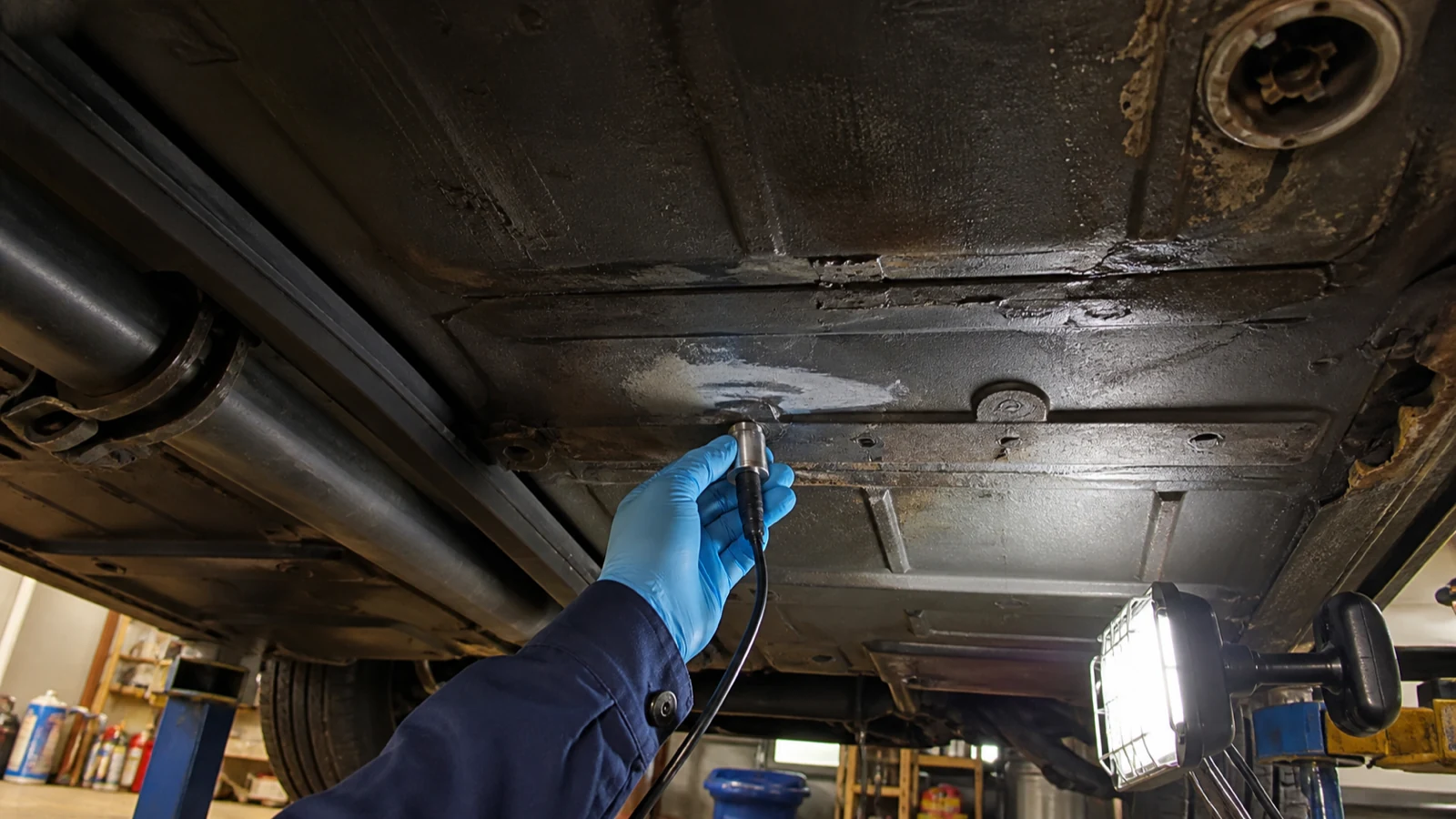
Check car floor pan rust thickness DIY UK: map metal before you weld
To check car floor pan rust thickness as a DIY job, use a handheld ultrasonic metal thickness tester only as a screening tool. Clean small access points to bare, sound metal, use couplant, verify the gauge on a reference, set it for steel, and map repeatable readings across the pan, sill edge and suspect patches before deciding whether a local repair or panel replacement is realistic.
This is different from using a paint thickness meter. Paint gauges are useful for bodywork history; ultrasonic wall-thickness tools estimate the remaining metal from sound travel through the part. UK tool guidance from Testron Group covers surface preparation, couplant and calibration-block checks for ultrasonic metal thickness measurement, while York Survey's Portagauge listing shows how higher-spec tools can include through-coating modes. A basic DIY meter may not have that through-coating capability, so assume paint, filler and underseal can distort the result unless the tool says otherwise.
Floor pan rust mapping workflow
- Inspect first. Do not probe metal that is flaking, perforated or structurally unsafe to support the vehicle.
- Remove loose underseal, dirt and heavy rust scale from small test patches.
- Check the gauge against its reference block or a known steel sample before the car panel.
- Mark a simple grid with tape or chalk. Include the visibly bad area and apparently sound metal nearby.
- Take repeat readings at each point. If the number jumps around, improve surface prep before trusting it.
- Photograph the grid and record the minimum stable readings for your repair notes.
Patch, replace or escalate?
| Finding | What it suggests | Practical response |
|---|---|---|
| Consistent readings across clean metal | Useful DIY screening evidence | Plan the repair using your own threshold and workshop judgement |
| Readings collapse near seams or mounts | Localised rust may extend beyond the visible patch | Open the area further before welding a small patch |
| Paint, filler or underseal cannot be removed | Single-echo readings may be false | Use a suitable through-coating instrument or remove coating safely |
| MOT, insurance or structural sign-off is involved | DIY data is not a certificate | Use a competent professional assessor |
What not to claim from a DIY reading
Do not claim the car is structurally safe because one floor-pan reading looked acceptable. A floor pan is part of a wider structure with seams, mounts, reinforcements and previous repairs. Ultrasonic readings are most useful for reducing guesswork before cutting and welding, not for replacing an MOT tester, bodyshop inspection or engineering judgement.
For related tool choices in a garage or fabrication space, see budget workshop gauge choices. If you are still unsure what an ultrasonic wall meter is doing, start with non-destructive wall-thickness gauge basics before buying anything.
FAQ
Will it read through underseal?
Only some instruments are designed for through-coating work. With a basic meter, expect to clean to a suitable contact surface.
Can aluminium panels be measured the same way?
The same principle applies, but the material velocity changes. A steel setting on aluminium will give the wrong result.