Cheap Ultrasonic Thickness Gauge That Actually Works UK: What to Verify
A cheap ultrasonic thickness gauge can work in a UK small workshop when it covers your thickness range, lets you set sound velocity, supports a reference check, and you keep couplant discipline—otherwise the saving disappears in rework. Premium industrial kits still exist for coded or multi-echo work; for context, a UK survey supplier lists a multiple-echo Portagauge-class meter at about £3,000 on the York Survey Portagauge 6 thickness meter page.
Decision table: must-have vs premium-only
| Buyer need | Must-have on a budget meter | Often premium-only |
|---|---|---|
| Job fit | Range covers your thinnest and thickest parts | Thru-paint / multi-echo modes |
| Materials | Adjustable or selectable sound velocity | Large onboard material libraries + A-scan |
| Confidence | Reference block or built-in check + couplant | UKAS certificate bundles and datalogging suites |
| Workflow | Stable single-point readings you can log by hand | High-volume memory, alarms, PC software |
Selection guidance also stresses matching corrosion versus precision duties and standards practice such as ISO 16809—see this ultrasonic thickness gauge selection encyclopedia.
Verification steps before you trust workshop numbers
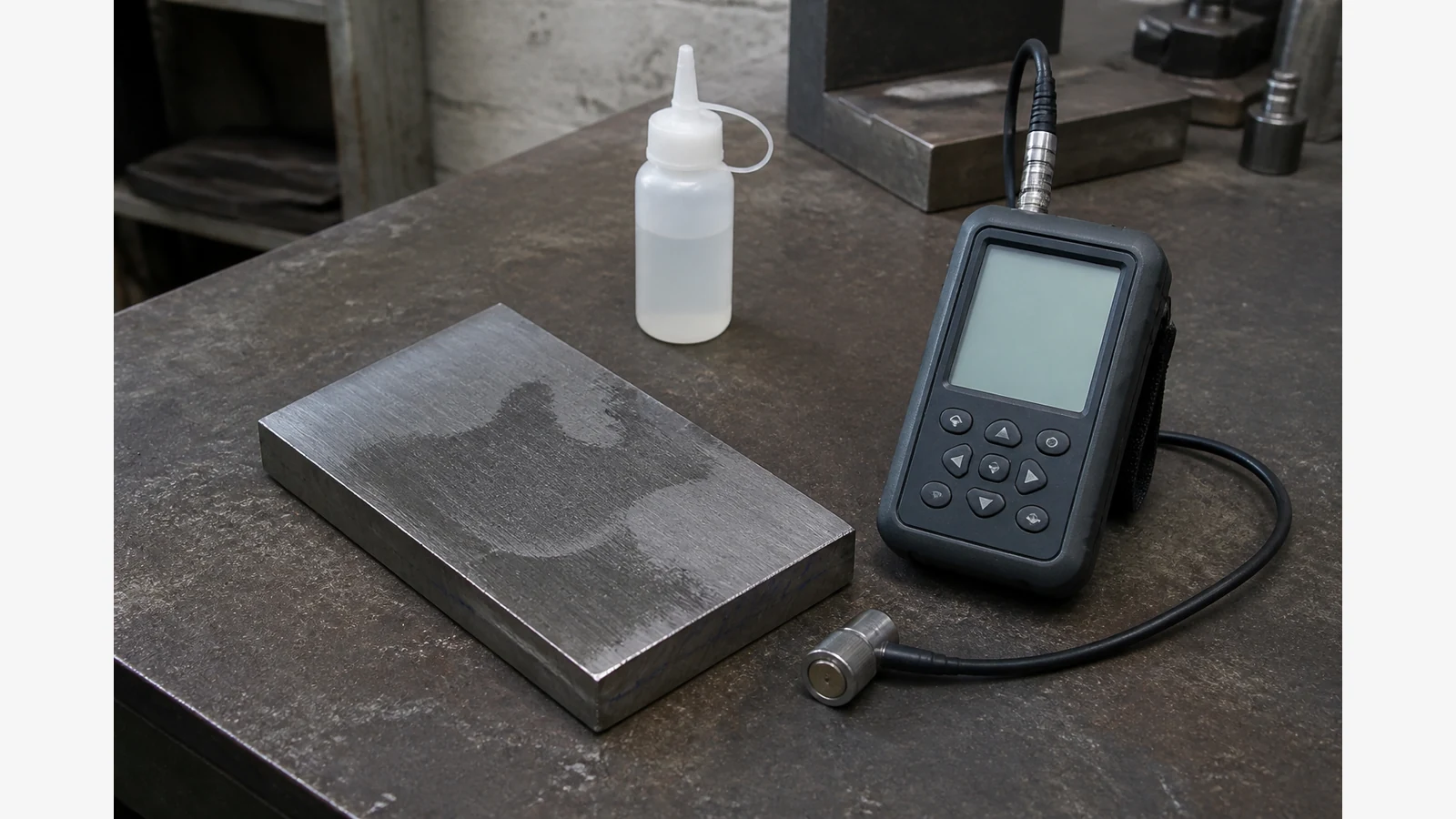
- Measure a known mild-steel coupon after a reference check.
- Change velocity deliberately and confirm the reading moves the wrong way when velocity is wrong.
- Repeat on a second material only after resetting velocity.
- Reject meters that cannot hold a stable reading on clean, flat steel with fresh couplant.
A concise UK buying checklist covering range, resolution needs, and calibration support appears in this UK ultrasonic metal thickness gauge buying guide.
Who should not buy the cheapest meter
- Teams writing certified pressure-system or marine reports
- Jobs that require measuring through thick coatings without preparation
- Anyone who will not maintain couplant, cleaning, and daily reference habits
If calibration discipline is your bottleneck, read the built-in calibration block daily routine. Apprentices starting from zero should use the beginner NDT thickness gauge checklist. When the criteria above match a compact handheld, review the DigitalUlt digital ultrasonic thickness gauge.